
All prices below are US prices checked in early November 2026 on the sellers' and labs' own pages. They move often, so treat them as a budget, not a quote.
What one disposable camera really costs
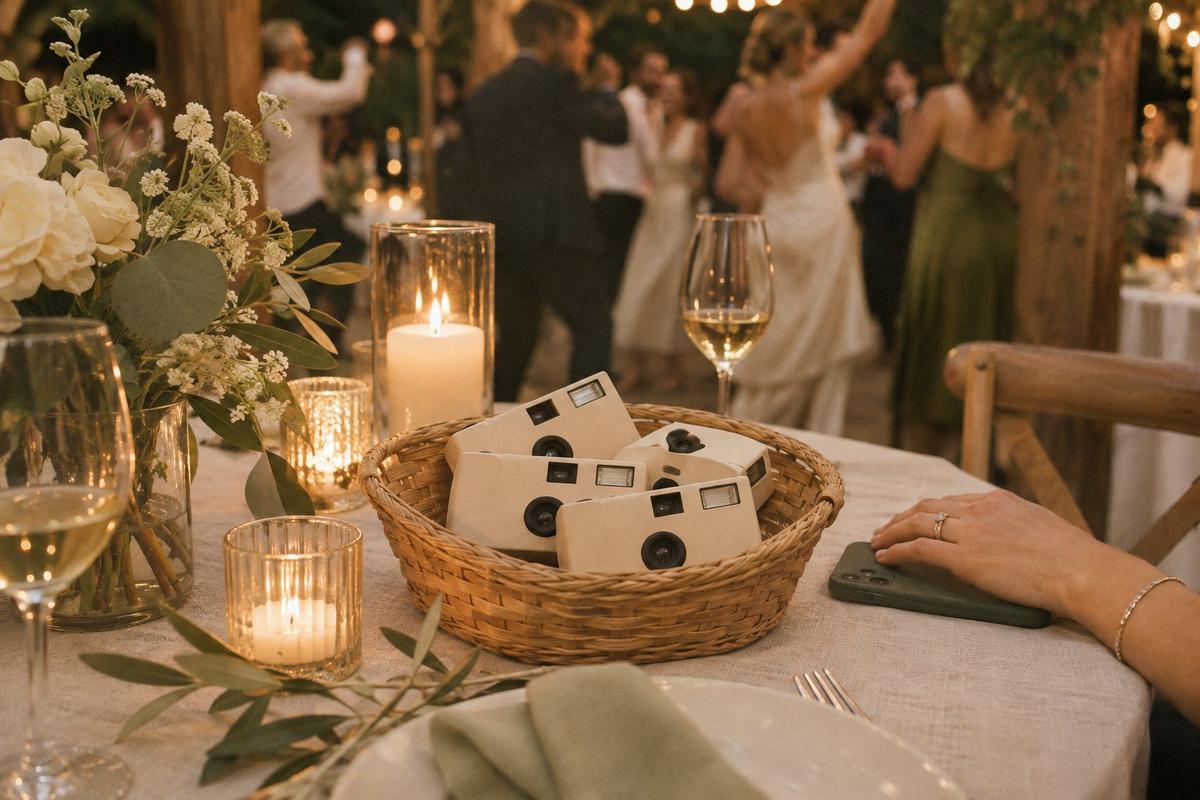
The camera. The classic wedding choice, the Fujifilm QuickSnap Flash 400 with 27 exposures and a built-in flash, cost $19.49 on Amazon on November 2, 2026 ($19.99 at camera shops such as Stewart's Photo). A Kodak FunSaver was $22.80. Buying a 10-pack barely helps: about $18.70 per camera.
The developing. Walgreens lists $15.99 per 24-exposure roll with a photo CD, ready in 3 to 5 business days, and does not return the negatives. Mail-in labs return them: The Darkroom starts at $17 with scans, Dwayne's Photo at $7.50 to develop plus $4 for scans and $5 shipping, Mpix at $13.95 with scans.
Total: about $35 per camera once developed ($19.49 + $15.99), for a maximum of 27 photos. That is roughly $1.30 per shot, including the ones that come out black.
The cost for a 100-guest wedding
Three common set-ups, at about $35 per camera all in:
| Set-up | Photos (max) | Cost |
|---|---|---|
| 10 cameras (one per table) | 270 | ≈ $355 |
| 25 cameras (one per 4 guests) | 675 | ≈ $890 |
| 50 cameras (one per couple) | 1,350 | ≈ $1,775 |
For comparison, a whole QR-code wedding album costs $29 once: about the price of a single developed camera, with no limit on guests, photos or videos, and everything in original quality the same night.
Also count the time: someone has to collect the cameras at the end of the night, take or mail them to the lab, and wait one to three weeks for the scans.
How to get good photos from disposable cameras
1.One camera per table, not per guest
One camera per guest triples the budget and most of them come back half used. One per table, or one per 4 or 5 guests, is the usual sweet spot.
2.Number every camera
A sticker with the table number tells you where each roll came from, and makes it easy to check at the end of the night that none is missing.
3.Add a prompt card
A small card next to the basket: "Take a photo of the couple dancing", "Your table's best smile". Guests shoot more and better with a mission. Ready-made ideas: wedding photo challenges.
4.Flash on, always
Most receptions are dark. Remind guests to turn the flash on and to stay within about 10 feet of the subject, the range of the built-in flash. Beyond that, photos come out black.
Tip: write "Flash on!" on the prompt card.
5.Name a collector
Ask a bridesmaid, a groomsman or the venue coordinator to gather every camera before guests leave. Cameras that go home in a pocket rarely come back.
6.Choose a lab that returns scans and negatives
Ask for digital scans so you can share the photos, and keep the negatives for prints later. Drugstore developing is convenient but usually keeps the negatives.
Alternatives to disposable cameras
7.A QR-code photo album
Guests scan a QR code on the table with their phone camera and add their photos and videos to your shared album from the browser, with no app and no account. No film to buy or develop, no 27-shot limit, and you see everything the same night. That is how Easy Wedding Album works.
Tip: put the QR code on the same table cards as the disposables: guests use whichever they prefer.
8.Mix both: a few cameras for the vibe
Keep two or three disposables on the dance floor or the lounge for the film look, and let the QR album collect everything else. You get the nostalgic prints without paying for 25 rolls.
9.A live slideshow instead of waiting weeks
With a shared album, a live slideshow on a TV or projector shows guests' photos as they arrive. It is the opposite of disposables: instant instead of three weeks later.
10.Disposable-camera style apps
Some apps imitate disposables: a limited number of shots per guest, photos revealed the next morning. Fun, but usually priced by number of guests and they require an app download. See our comparison with POV.
Disposable cameras or a QR album?
- Choose disposable cameras if the film look is part of your wedding style, you have a small guest list and a budget for developing.
- Choose a QR album if you want every guest's photos and videos, in original quality, the same night, for one small payment.
- Or both: a handful of disposables for the atmosphere, the QR album for everything else.
Our advice
The cameras cost little; it is developing them that adds up. Compare the full price, not the price on the box, then decide how many rolls you really want. More on collecting guests' photos: how to collect wedding photos from guests.
Frequently asked questions
How many disposable cameras do I need for a wedding?
Most couples put one camera on each table, so about 10 cameras for 100 guests. One camera per table gives you at most 27 shots per table, so if you want guests to really use them, plan one camera for every 4 or 5 guests instead, which means 20 to 25 cameras for 100 guests.
How much do disposable cameras for a wedding cost?
In November 2026 a Fujifilm QuickSnap Flash 400 (27 exposures) cost about $19.49 on Amazon, and developing cost $15.99 per roll at Walgreens or from $17 with scans at The Darkroom. That is roughly $35 per camera once developed: about $355 for 10 cameras, $890 for 25 and $1,775 for 50.
How much does it cost to develop a disposable camera?
Walgreens lists $15.99 per 24-exposure roll with a photo CD, ready in 3 to 5 business days, without the negatives. Mail-in labs charge from about $11.50 (Dwayne's Photo, develop and scans plus shipping) to $17 with scans at The Darkroom, and they return the negatives.
Are disposable cameras worth it at a wedding?
They are fun and give a real film look, but you pay for every camera and every roll, you wait days or weeks for the photos, and night shots taken beyond the flash's range of about 10 feet come out dark. They are worth it as a small extra for the atmosphere, less as the main way to collect your guests' photos.
What is the best alternative to disposable cameras at a wedding?
A QR-code photo album: guests scan a code on the table with their own phone and add their photos and videos to a shared album, with no app. There is no film to buy or develop, no limit of 27 shots, and you see the photos the same night.